
▶ BSF Automoción brand · ISO 9001:2015 · 24h delivery
The component that converts pedal force into hydraulic pressure. BSF Automoción supplies brake master cylinders for the professional aftermarket, with stock availability and 24-hour delivery.
Available B2B channel · 24h delivery · 40+ years supplying the aftermarket
What is the brake master cylinder?
The brake master cylinder is the central component of the brake hydraulic circuit. Its function is to convert the mechanical force the driver applies to the brake pedal — amplified by the brake booster / servo — into hydraulic pressure transmitted through the lines to the wheel cylinders and brake calipers on each axle.
Without a brake master cylinder in correct condition, the braking system cannot generate or maintain the required pressure. It is therefore a safety-critical component whose replacement admits no delays or partial solutions.
The tandem master cylinder — the most common type in today’s vehicle parc — generates hydraulic pressure in two independent circuits via two pistons in series. If one circuit fails, the other maintains a minimum braking capacity to bring the vehicle to a stop, which is key for passive safety.
What is the brake master cylinder?
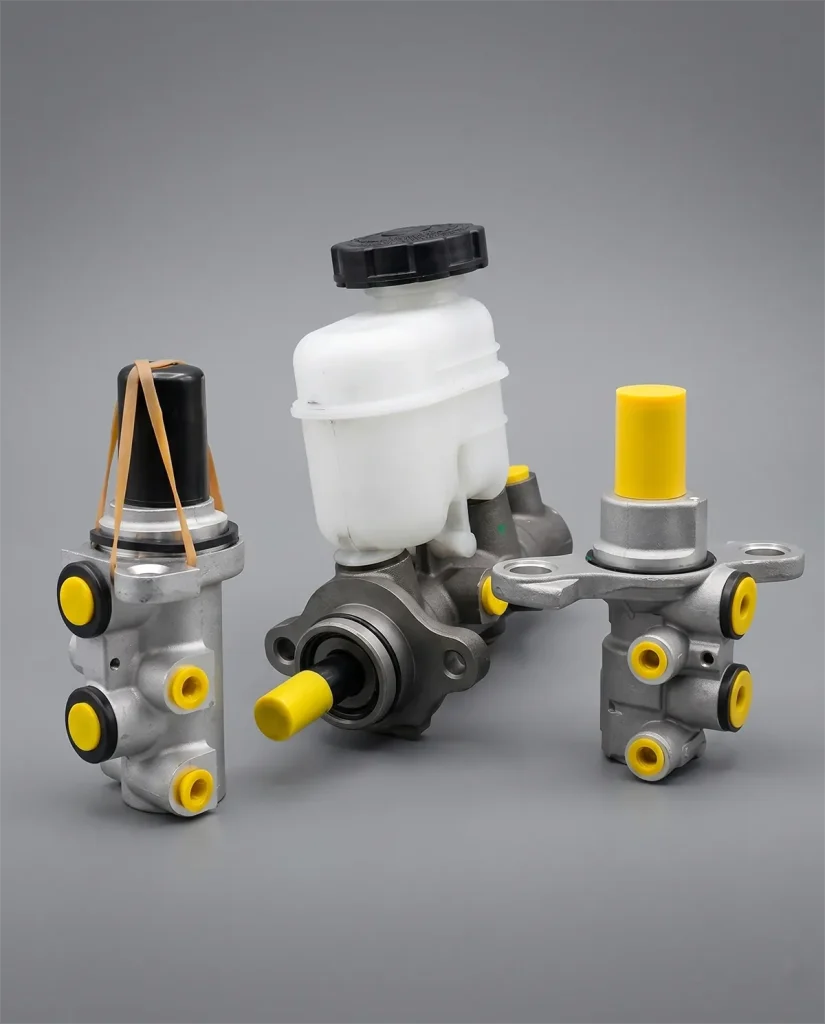
Depending on their construction and configuration, brake master cylinders are classified into four types. The correct choice depends on the specific vehicle application.
The brake fluid reservoir is integrated into the cylinder body. This reduces connections and the risk of leaks. The most common design in modern passenger cars.
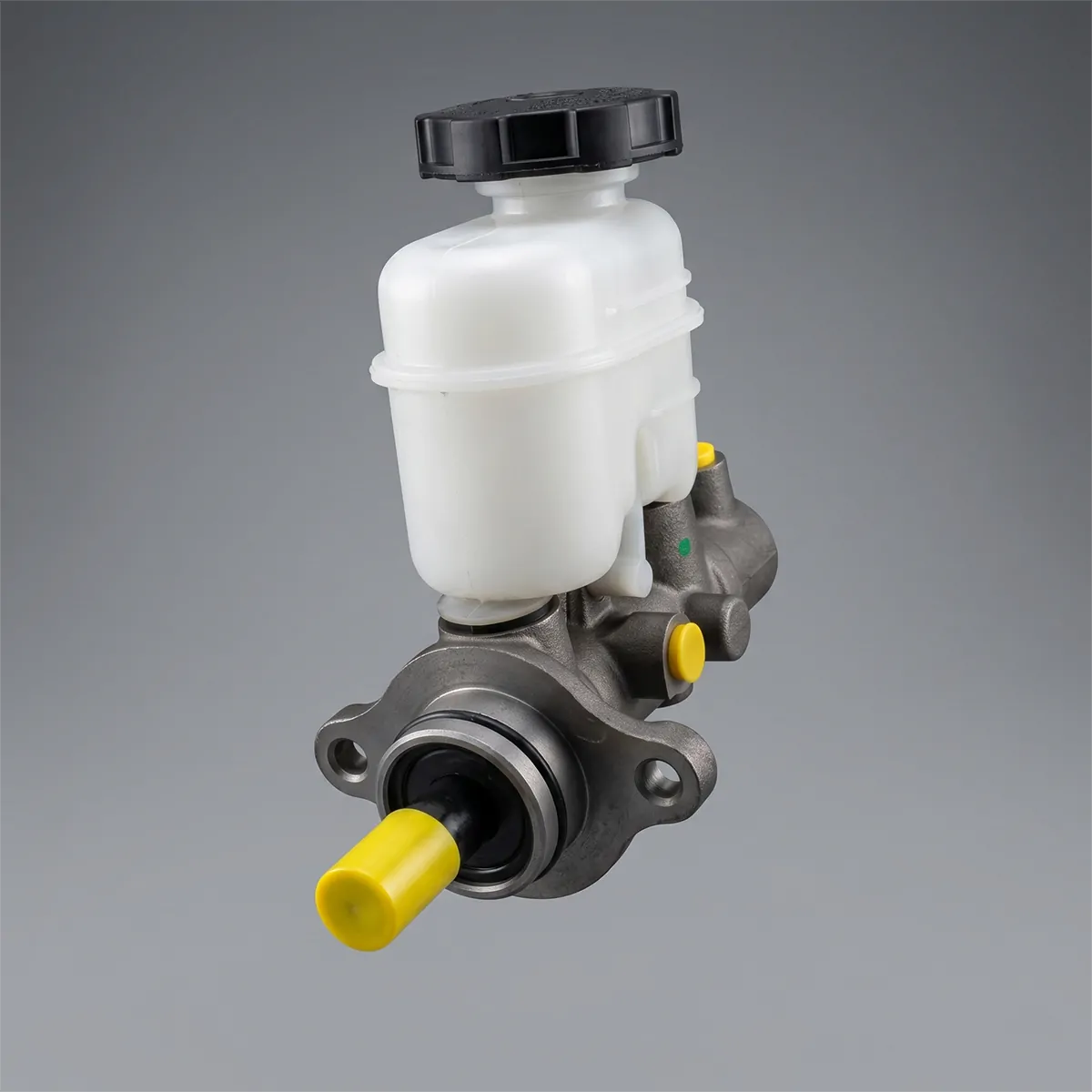
The reservoir is mounted independently and connected by a hose. Common in light commercial vehicles and applications with limited engine bay space.
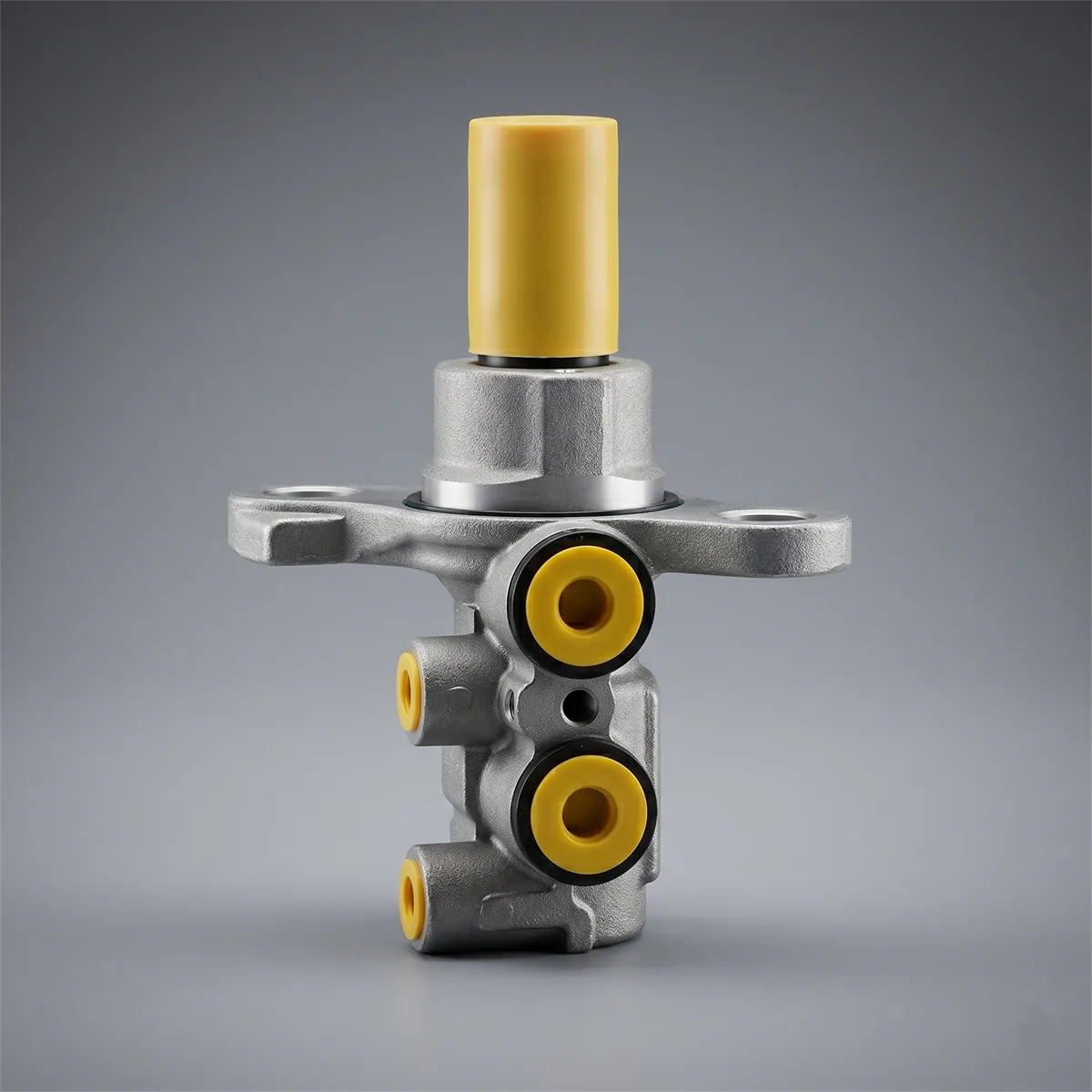
Two pistons in a single body, two independent circuits. Standard design since the 1970s. If one circuit fails, the other maintains minimum braking capacity.
Modern design with a centre valve. Fewer internal components, up to 20% less weight. Greater resistance to contamination and longer seal service life.
Fault symptoms
Unlike brake pads or brake discs, the brake master cylinder has no predefined replacement interval. It is replaced on failure. Symptoms indicating loss of sealing or pressure capacity:
The most common failure is loss of sealing in the internal piston seals. Brake fluid bypasses the piston instead of pressurising the circuit. The result: a spongy pedal, excessive travel, or a pedal that sinks to the floor. This failure is not visible externally — there is no leak, but the cylinder has lost its pumping capacity.
The recommended practice is complete assembly replacement. BSF supplies complete brake master cylinders, ready for direct installation, with new-component warranty.
Gama BSF · Especificaciones técnicas
BSF Automoción supplies approved brake master cylinders for passenger cars, SUVs and light commercial vehicles. All components are selected to OEM quality criteria and undergo quality control prior to despatch.
| Feature | Detail |
|---|---|
| Construction type | Aluminium body or cast iron depending on application. Treated steel pistons. High chemical-resistance rubber seals. |
| Configuration | Tandem master cylinder with two independent circuits. Compatible with ABS, ESP and EBA systems. |
| Piston diameter | From 15.8 mm to 35 mm depending on application. |
| Reservoir | Integral or separate depending on part number. Polyethylene material resistant to DOT 3, DOT 4 and DOT 5.1 brake fluid. |
| Surface treatment | Hexavalent chromium-free (Cr+6). Complies with European ELV Directive for vehicles from 2003. |
| Certification | ISO 9001:2015 (LRQA LRQA). |
| Compatibility | Passenger cars, SUVs and light commercial vehicles up to 3.5 tonnes. |
Covered Vehicle Brands
Why BSF
Exclusive specialisation in brakes, over 40 years in the sector and a B2B model that places the distributor at the centre of the supply chain.
BSF manufactures and distributes braking systems only. Deep technical expertise and a complete range for the professional aftermarket, with no gaps and no distraction from other product categories.
Average service level of 97%. Back orders below 3%. Distributors can commit to their workshops without relying on uncertain lead times or second-choice alternatives.
Quality management system certified by LRQA. Traceability and control throughout the entire logistics and distribution process across the full BSF catalogue.
Same-day order processing for distributors and warehouses. Direct commercial support with no intermediaries.
BSF does not sell to garages or end consumers. The distributor has exclusive access to the channel and does not compete with its supplier in the market.
Quality management system compliant with ISO 9001, audited and certified by LRQA. Guaranteeing standardised processes, traceability and continuous control in production and distribution across the full BSF catalogue.
Answers to the most common aftermarket channel questions about the brake master cylinder.
They are the same component. ‘Brake pump’ is the colloquial term used in the aftermarket sector; ‘brake master cylinder’ is the correct technical designation. Both terms are used interchangeably in parts catalogues. It may also appear as ‘main brake cylinder’.
Yes, it is always recommended. When replacing the brake master cylinder, the brake hydraulic circuit should be bled and the brake fluid renewed. If the reservoir has been in service for some time, it may have accumulated sediment or show cracks in the plastic. Replacing the complete assembly eliminates any risk of contaminating the new component.
Yes, it is mandatory. When removing the cylinder, brake fluid is lost and air enters the circuit. Correct brake bleeding starts at the wheel furthest from the master cylinder (usually rear right) and ends at the nearest (front left in most European vehicles). Failure to bleed correctly can leave air bubbles that drastically reduce braking efficiency.
Technically possible on some models using seal kits and piston repair kits. However, in the professional aftermarket channel the standard practice is complete assembly replacement. Labour costs typically exceed the price of a new brake master cylinder. BSF supplies complete brake master cylinders, ready for direct installation.
Yes. BSF brake master cylinders are compatible with vehicles fitted with ABS (Anti-lock Braking System), ESP, EBA and autonomous emergency braking systems. The brake master cylinder is a primary hydraulic circuit component that does not interfere with the electronic stability control system. It is selected by OE reference to guarantee exact compatibility.
The BSF range covers the main manufacturers in the Spanish and European vehicle parc: Volkswagen, Seat, Skoda, Audi, BMW, Mercedes-Benz, Opel, Renault, Peugeot, Citroën, Fiat, Ford, Toyota, Hyundai, Kia, Nissan, Mazda, Honda, Alfa Romeo, Lancia, Volvo, Land Rover, Porsche, Mitsubishi and Subaru. Consult the technical catalogue at bsf.es to confirm the exact part number.
BSF Automoción offers delivery within 24 working hours for distributors, warehouses and distribution groups. With an average service level of 97%, stock availability is guaranteed for the vast majority of catalogue part numbers.
No, this is not normal. It is an unmistakable symptom of brake master cylinder failure, possibly due to internal wear or loss of hydraulic pressure in the circuit. In this situation the vehicle has no reliable braking capacity and presents a serious safety risk. Stop the vehicle immediately, do not drive it, and have it transported by recovery vehicle to a trusted garage for replacement of the master cylinder as soon as possible.
Although it may appear that the new master cylinder is responsible, in most cases the cause lies elsewhere. The most common causes, in order of frequency:
1. Air in the brake hydraulic circuit.
If brake bleeding was not carried out correctly when the master cylinder was replaced, or if the brake fluid was not renewed, there may be trapped air in the circuit. Unlike brake fluid, air is compressible, which causes the pedal to give way without transmitting pressure correctly. The solution is a complete brake fluid change and thorough bleeding of the circuit.
2. Contaminated brake fluid.
Brake fluid absorbs moisture over time. Water in the circuit reduces the boiling point and can produce vapour, with the same effect as air. Additionally, solid particles are sometimes found inside the circuit, frequently originating from the brake fluid reservoir, which can interfere with system operation.
3. Defective new master cylinder.
Less common, but not to be ruled out. A faulty part or incorrect installation can produce the same symptoms.
The first recommended action is always a complete brake fluid change and full bleeding of the circuit before considering replacing the master cylinder again.
BSF brake master cylinders are available exclusively to distributors, warehouses and distribution groups in the aftermarket channel. Request access to our technical catalogue and B2B commercial terms with no obligation.
Available B2B channel · Not sold to garages or end consumers · Direct commercial support